
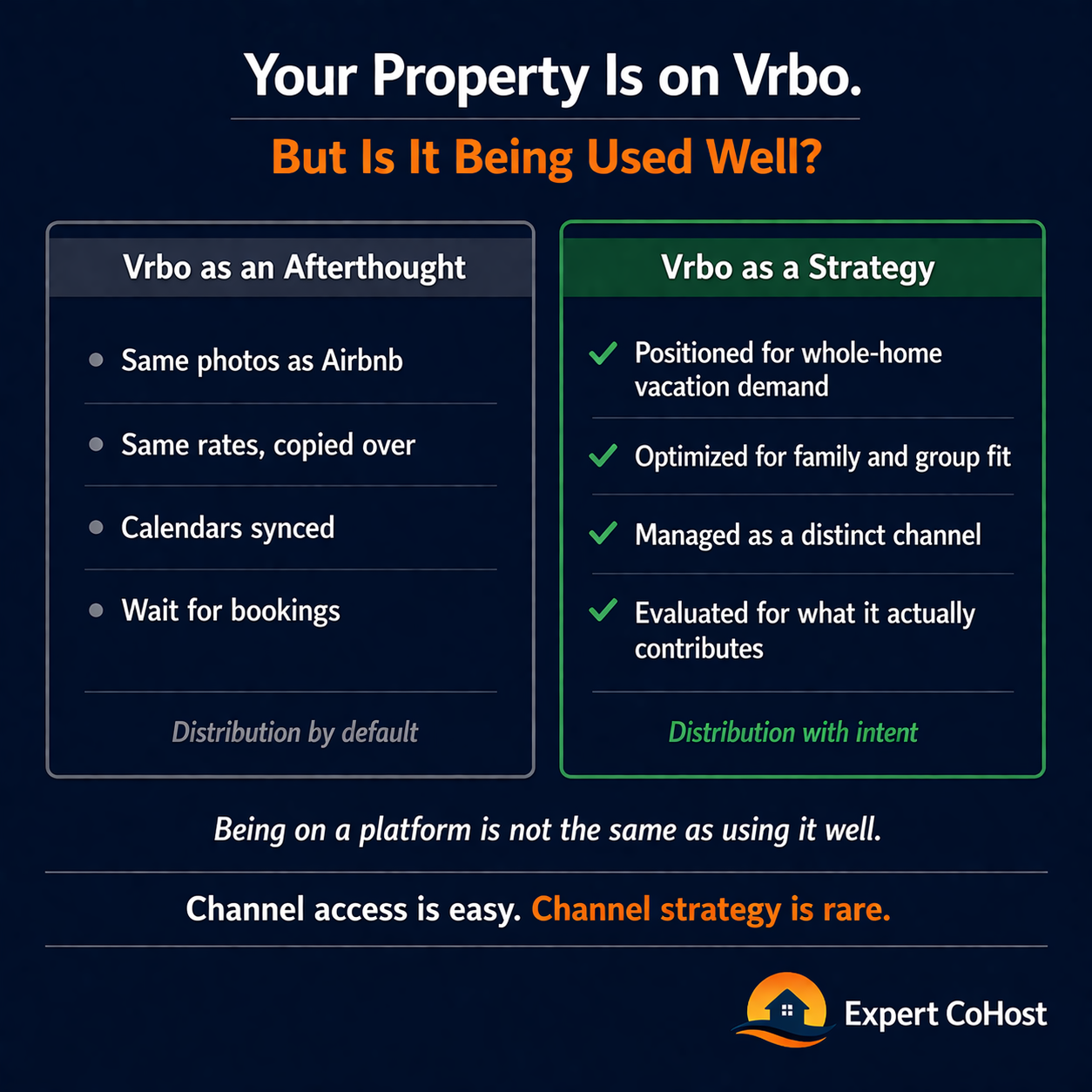
A lot of property managers treat Vrbo too casually.
They know it matters.
They know it can produce bookings.
They know many whole-home vacation rentals should be there.
But beyond that, the thinking often gets shallow.
The property is pushed live.
The calendars are synced.
The rates are copied over.
The same photos are used.
The same messaging is used.
Then everyone waits to see what happens.
That is not really strategy.
And that is where many owners should start paying closer attention.
Because Vrbo is not just a backup channel or a second copy of Airbnb. It is an important booking platform with its own role in the vacation-rental ecosystem, its own strengths, and its own operational implications. Managers who understand that tend to use it far more effectively than the ones who simply treat it as another place to distribute inventory.
That distinction matters.
A property can absolutely be listed on Vrbo and still be under-managed there.
And that is often exactly what happens.
Vrbo Is Important — But Often Underthought
Vrbo remains one of the most important booking platforms for whole-home vacation rentals.
That alone should make owners cautious.
Because when a platform matters, surface-level management is not enough.
Yet many property managers still think about Vrbo in a very narrow way. They view it as another source of exposure, another channel to turn on, another box to check.
Of course the property should be on Vrbo.
Of course the bookings are welcome.
Of course wider distribution helps.
Sometimes that is as far as the thought process goes.
But that mindset misses something important.
Vrbo should not just be “included.” It should be understood.
A good manager should be able to explain what Vrbo is expected to contribute to the property’s booking mix, where it is likely to be useful, how it differs from other channels operationally, and what kind of demand it is actually helping attract.
If the answer is just, “We list on Vrbo too,” that is not much of a strategy.
What Vrbo Is Best For
Vrbo is especially relevant for whole-home vacation rentals.
That matters.
Because not every booking platform is centered around the same kind of trip planning behavior, and not every channel plays the same role in how guests search. Vrbo has long been associated with vacation-home demand, family travel, and travelers looking specifically for an entire place to stay.
That gives it a clear strategic use.
Vrbo is often strongest when the property is well-suited for leisure travel, group travel, family trips, destination stays, and guests who are intentionally shopping for a vacation home rather than casually browsing all kinds of accommodations.
That does not mean every Vrbo guest fits one neat profile.
It does mean the platform tends to make the most sense when the property clearly fits the whole-home vacation-rental model and when the manager understands how to present it accordingly.
That is where a lot of managers fall short.
They treat Vrbo like a distribution copy instead of a channel with a distinct role.
Vrbo Should Be Part of a Strategy — Not Just Added to One
One of the biggest mistakes property managers make is assuming that a good distribution strategy means being present on as many major channels as possible.
That sounds smart.
But being present is not the same as being intentional.
A real strategy asks a better question:
What is Vrbo doing for this property that strengthens the overall mix?
That is the question owners should be asking.
Is Vrbo broadening family and leisure reach?
Is it helping diversify demand away from overdependence on one platform?
Is it supporting stronger occupancy at certain times of year?
Is it attracting bookings that fit the property particularly well?
Is it contributing useful reach without creating disproportionate friction?
Those are the questions that matter.
Without them, “we’re on Vrbo” does not tell you very much.
What Many Property Managers Miss About Vrbo
This is where the gap starts to show.
A lot of property managers understand how to syndicate a listing to Vrbo.
Far fewer understand how to manage Vrbo as a real performance channel.
They often assume that if the property is already optimized on Airbnb, the same work automatically carries over.
That is lazy thinking.
The same photos may not carry the listing equally well everywhere.
The same title may not be the strongest fit.
The same emphasis may not create the same confidence.
The same guest questions may not show up.
The same operational friction may not be perceived the same way.
That does not mean Vrbo needs a completely separate universe of management.
It does mean it deserves more thought than simple duplication.
The average manager tends to stop at distribution.
The better manager thinks about contribution.
Vrbo Is Not Just About Visibility — It Is About Fit
This is an important point.
Not all exposure is equal.
A booking channel can bring more eyeballs without necessarily bringing better-fit bookings. It can expand reach without improving results. It can create more opportunities while also increasing complexity.
That is why channel fit matters.
Vrbo is most valuable when it fits the property, the stay type, and the operating model well.
For example, a property that clearly serves families, small groups, or destination travelers looking for a full-home experience may benefit from having a strong Vrbo presence. In those cases, the platform can be a meaningful source of bookings that complements other channels well.
But that benefit is not automatic.
It depends on whether the property is being positioned clearly, the stay experience supports the expectations the listing creates, and the manager understands the role the channel is supposed to play.
A lot of managers skip that part.
They assume the platform name is enough.
Vrbo Can Be Valuable for Diversification
This is one of the strongest reasons to take Vrbo seriously.
Overdependence on one booking source is risky.
When a property relies too heavily on a single platform, changes in ranking, policies, guest behavior, seasonality, or platform dynamics can have an outsized impact on performance. A healthier distribution strategy usually spreads that risk more intelligently.
Vrbo can help with that.
It can give a property a broader base of visibility. It can reduce dependence on one channel. It can create a more balanced booking mix over time.
But again, diversification only helps when it is managed with thought.
If a property manager adds Vrbo but does not really monitor what kind of performance it is contributing, what kinds of bookings it is generating, or how it affects the property operationally, then diversification becomes more theoretical than strategic.
The existence of multiple channels is not the same as real balance.
Where Vrbo Can Expose Weak Management
This is where owners should be more skeptical.
A manager who does not really understand Vrbo may still produce bookings there.
That is what makes shallow management hard to spot.
The property gets listed.
A few bookings come in.
The channel appears to be working.
But that does not mean it is being managed well.
Weak management often hides in questions like:
Is the listing truly positioned well for the platform?
Is the property information helping the right guests self-select?
Are pre-arrival questions being reduced effectively?
Is the communication flow helping build confidence?
Are channel-specific issues being noticed and improved over time?
Is the manager actually evaluating the value of the channel, or just accepting whatever it produces?
Those are the kinds of questions that reveal whether Vrbo is being used intentionally or passively.
Most property managers do not want owners asking those questions.
They should ask them anyway.
Vrbo Is Not a “Set It and Forget It” Channel
This is another place many managers underperform.
They assume that once the property is listed, the work is mostly done.
That is not how strong channel management works.
A real manager should be paying attention to how the property performs across platforms, where the friction shows up, which channels bring smoother bookings, which ones require more hand-holding, where the guest fit is strongest, and where improvements should be made.
That includes Vrbo.
If the property manager never revisits the positioning, never refines the presentation, never evaluates how the channel is performing relative to the rest of the mix, and never explains what role Vrbo is supposed to play, then the property is not being strategically managed there.
It is just being distributed there.
There is a big difference.
What Owners Should Ask Their Property Manager About Vrbo
Owners do not need to become platform specialists.
But they should ask sharper questions.
For example:
Why is Vrbo part of my distribution mix?
What kind of bookings is it expected to bring?
How does it complement the other channels?
What kind of guest fit does it tend to produce for my property?
How is the property being positioned well on Vrbo specifically?
What operational strengths or weaknesses show up there?
How do you know whether Vrbo is adding real value?
Those are useful questions because they force the manager to move beyond generic language about exposure.
A manager who really understands Vrbo should be able to answer them with confidence and clarity.
A weak manager usually cannot.
The Bigger Point
Vrbo is not the issue.
Management depth is the issue.
The problem is not whether the property is on the platform.
The problem is whether the person managing that presence actually understands what the platform is good at, how it fits into the booking mix, and how to use it deliberately rather than lazily.
That is where many owners get misled.
They assume multi-channel distribution automatically means strategic distribution.
It does not.
A property can be visible on multiple channels and still be managed with very little real thought.
And that kind of shallow management often costs owners more than they realize.
Final Thought
Vrbo can be a very valuable part of a strong vacation-rental distribution strategy.
But it should not be treated like an afterthought.
And it should not be treated like a duplicate copy of another platform.
The best property managers do not just push listings onto Vrbo because it is one of the major channels. They understand why it belongs in the mix, what kind of demand it helps attract, how it complements other booking sources, and how to manage it with intention.
That is what owners should be paying for.
Not just channel access.
Real channel strategy.