
After looking at how listings shape the type of guests they attract, a natural question follows:
Why do so many properties end up competing on price—even when they don’t have to?
Most owners assume the answer is demand.
Too many listings. Too much competition.
So the response is predictable:
Lower the price. Stay competitive. Fill the calendar.
But in many cases, price isn’t the root issue.
It’s what happens when something else is missing.
Most Listings Don’t Look Bad — They Look the Same
Scroll through almost any Airbnb market.
You’ll see:
- clean photos
- solid amenities
- reasonable pricing
Nothing stands out as obviously broken.
But very few listings feel clearly distinct.
From a guest’s perspective, the options blur together.
And when everything feels similar, the decision becomes harder—not easier.
When Choice Is Unclear, Guests Simplify
Guests aren’t trying to optimize perfectly.
They’re trying to decide quickly and confidently.
If they can’t clearly tell:
- which listing fits them best
- what makes one meaningfully different
- what experience they should expect
They reduce the decision to something easier.
Price becomes the shortcut.
Not because it matters most.
Because it’s the easiest thing to compare.
Price Competition Is Usually a Symptom
When listings rely on pricing to stay competitive, it often signals:
- unclear positioning
- weak differentiation
- missing context for the guest
Lowering the price can increase bookings.
But it doesn’t solve the underlying issue:
The listing isn’t easy to choose.
So it becomes easy to compare.
Strong Listings Don’t Eliminate Competition — They Change It
High-performing listings still compete.
But not in the same way.
Instead of competing across dozens of similar options, they:
- narrow the field
- signal clearly who they’re for
- create confidence early in the decision
This shifts the comparison from:
“Which one is cheapest?”
to:
“Which one fits best?”
And that’s a completely different decision.
Weak Positioning Expands the Competitive Set
When a listing is unclear, it doesn’t just struggle to convert.
It competes against more options.
Guests:
- keep browsing
- open more tabs
- compare more listings
And the more comparisons they make, the more price starts to matter.
Even a strong property can get pulled into price competition if it isn’t clearly positioned.
Why This Quietly Erodes Performance
Competing on price doesn’t just affect revenue.
It changes the entire performance profile of the property.
Over time, it leads to:
- tighter margins
- more price-sensitive guests
- higher review volatility
- less consistency
The listing may stay busy.
But it becomes harder to stabilize—and harder to improve.
This Is Where Guest Quality Starts to Shift
This connects directly to what we covered earlier:
Not all demand is equal.
When a listing competes primarily on price, it tends to attract:
- deal-focused guests
- comparison-driven decisions
- lower alignment with the experience
Which increases the likelihood of friction during the stay.
Price didn’t just fill the calendar.
It changed who showed up.
The Real Shift
Most owners try to solve performance issues by asking:
“How should I adjust my pricing?”
A better question is:
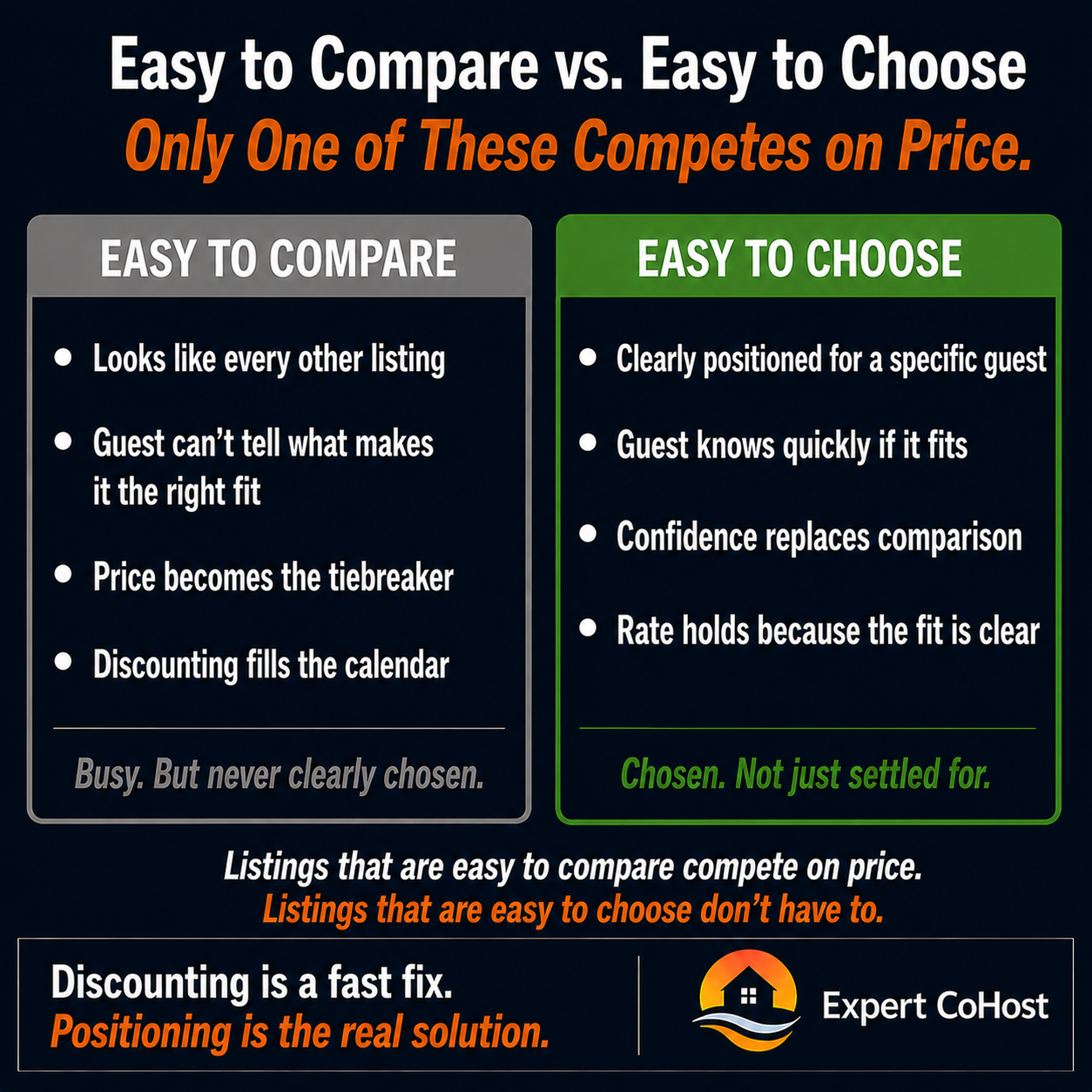
“Is my listing easy to choose—or easy to compare?”
Because listings that are easy to compare compete on price.
Listings that are easy to choose don’t have to.
What This Leads To
If guest quality is shaped by who books…
And who books is shaped by how clearly a listing is positioned…
Then the next question becomes:
What actually makes a guest choose one listing over another?
Not in theory.
But in real decisions, under time pressure, with dozens of options.
That’s where conversion really happens.