
Many vacation rental owners assume bookings are lost when guests find something better.
A better view. A better price. A better amenity package. A more impressive home.
Sometimes that is true.
But a lot of lost bookings happen for a quieter reason:
The guest hesitated.
They paused. They compared harder. They opened another tab. They decided to keep looking.
That moment matters more than many property managers realize.
Because on Airbnb, guests do not need to dislike your property for performance to weaken. They only need to feel slightly less confident choosing it.
That is often enough.
Most Lost Bookings Do Not Come From Rejection
Owners tend to think in binary terms.
Either the guest wanted the property or they did not.
Either the listing was competitive or it was not.
But booking behavior is rarely that clean.
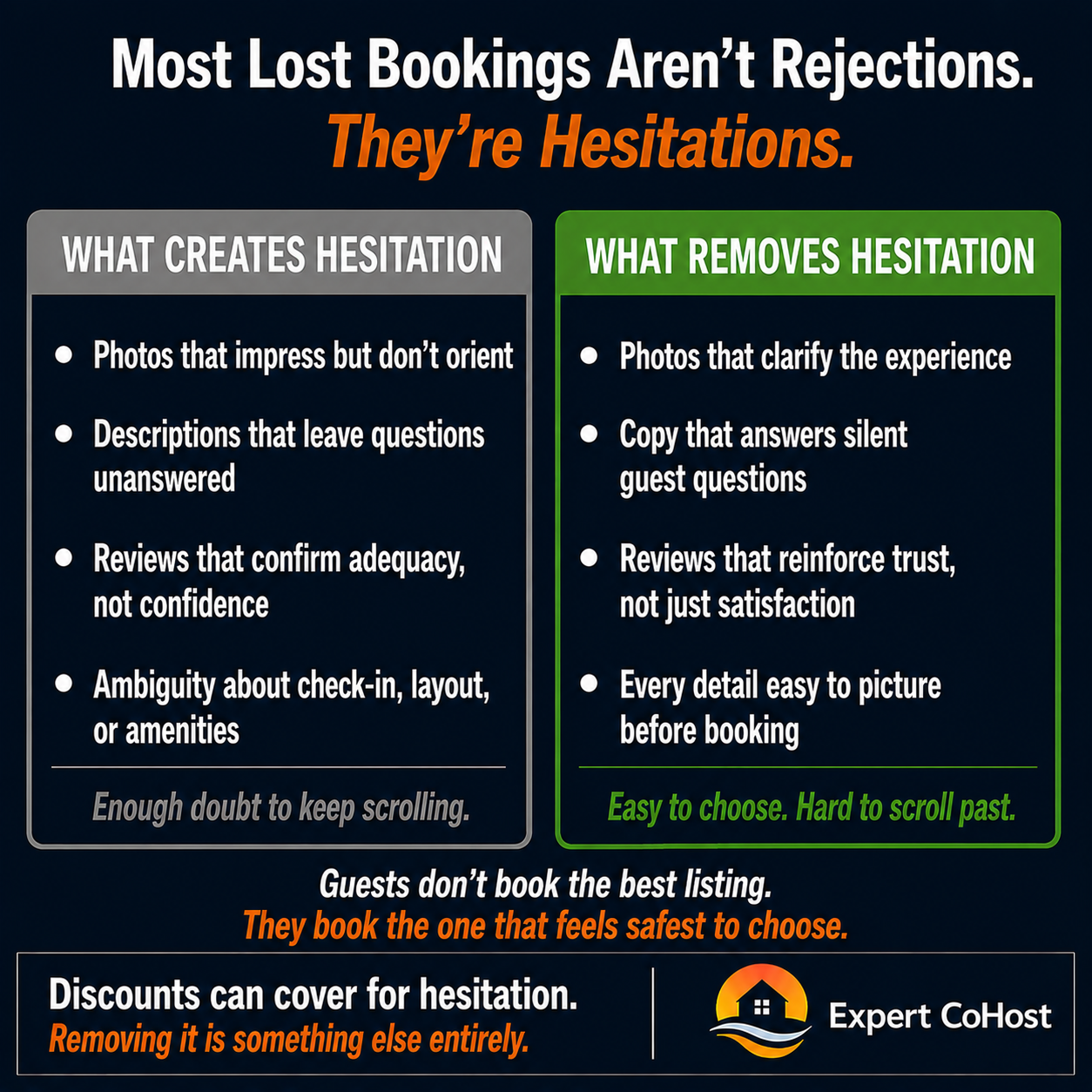
A lot of listings do not lose because they are clearly inferior. They lose because they create just enough uncertainty to interrupt momentum.
Not enough uncertainty to trigger a complaint.
Not enough uncertainty to look broken.
Just enough to make the guest hesitate.
And in a competitive marketplace, hesitation is expensive.
Because the listing that feels easiest to say yes to often wins.
Hesitation Is a Trust Problem Before It Is a Pricing Problem
When owners sense soft performance, pricing usually gets blamed first.
Maybe the rate is too high. Maybe the market is soft. Maybe the property just needs a better discount strategy.
Pricing matters.
But hesitation usually starts upstream from price.
Guests hesitate when something feels unclear, slightly inconsistent, or harder to trust.
They may not say that directly. They may not even fully recognize it themselves.
They just feel less certain.
That uncertainty can come from small things:
- reviews that feel positive but not enthusiastic
- photos that look polished but do not fully explain the space
- descriptions that sound nice but leave key questions unanswered
- house rules that feel hidden
- a layout that is hard to picture
- amenities that feel slightly ambiguous
- communication that sounds generic rather than reassuring
None of these need to be dramatic.
Together, they change how safe the booking feels.
That is the bigger point.
Guests do not book when a property looks acceptable.
They book when it feels easy to trust.
Guests Are Not Just Comparing Properties
They Are Comparing Risk
From the owner side, listings often look very similar.
Same market. Same bedroom count. Similar décor. Similar price.
So when one property converts more easily than another, owners often assume the reason must be obvious.
Usually, it is not.
Guests are not just comparing visible features. They are comparing perceived risk.
They are asking:
Will arrival feel smooth?
Will this look like the photos?
Will the instructions make sense?
Will the stay feel easy?
If something goes wrong, does this feel well-managed?
Most of that happens silently.
Guests do not submit a form explaining why they did not book.
They just choose the listing that feels calmer, clearer, and more reliable.
That is why hesitation matters so much. It is where trust breaks down before the stay ever begins.
Small Ambiguity Creates Outsized Drag
A lot of property managers still think only major flaws hurt performance.
Bad cleanliness. Poor reviews. Broken amenities. Slow responses.
Those things matter, of course.
But many underperforming listings do not have major flaws. They have minor ambiguity.
And ambiguity slows decisions.
A guest should not have to work to understand:
- where they will park
- how private the space feels
- what the sleeping setup really is
- whether stairs are involved
- how close neighbors are
- whether the hot tub, fireplace, or pool is truly usable
- what kind of arrival experience to expect
When those details are not clear enough, the guest has to fill in the blanks.
That usually does not create excitement.
It creates caution.
A weak manager sees none of this because nothing looks broken.
A stronger manager understands that friction often shows up first as hesitation.
Hesitation Rarely Shows Up Clearly in Dashboards
This is one reason owners miss it.
Dashboards show outcomes:
- occupancy
- revenue
- average nightly rate
- lead time
- review average
They do not show hesitation.
They do not show the guest who nearly booked.
They do not show the guest who felt unsure about the check-in setup.
They do not show the guest who liked the property, but chose another one because it felt easier to understand.
That is where owners should pay attention.
Because hesitation often appears before the obvious metrics weaken. By the time pricing pressure, shorter lead times, or softer reviews show up, the confidence problem is already old.
That is not just a dashboard blind spot.
It is a management blind spot.
Why Better Photos Do Not Always Fix It
When conversion feels weak, many owners are told to improve the photos.
Sometimes that helps.
But better photos are not the same as better reassurance.
A lot of listings have attractive photos and still create hesitation.
Why?
Because some photos impress without orienting.
They show style, but not flow.
They show details, but not context.
They make the property look appealing, but not necessarily easy to understand.
Guests do not just need to like what they see.
They need to feel grounded in what they are booking.
That means photos should do more than look polished. They should reduce uncertainty.
A stronger manager understands that presentation is not just about beauty.
It is about clarity.
Reviews Do More Than Prove Guests Were Satisfied
Reviews are one of the strongest anti-hesitation signals a listing has.
But not all positive reviews work equally hard.
“Nice place.”
“Everything was fine.”
“Good stay.”
Those reviews are not harmful. But they do not remove much doubt either.
Enthusiastic reviews do something different.
They reassure future guests that the stay felt smooth, easy, and worth choosing.
That distinction matters.
Guests are often reading reviews less for praise than for proof.
Proof that:
- the listing matches reality
- the stay went smoothly
- expectations were met
- small risks are unlikely to become annoyances
When reviews feel flat, even if the average rating is decent, hesitation increases.
That is one reason weak enthusiasm can quietly drag performance even when nothing appears obviously wrong.
Property Managers Often Treat Hesitation Like a Traffic Problem
This is where many owners get guided in the wrong direction.
The manager sees softer bookings and assumes the issue is reach.
So the response becomes:
- more channel exposure
- pricing changes
- promotions
- calendar adjustments
- more aggressive occupancy tactics
Sometimes those create short-term movement.
But they do not always address the real problem.
If the listing already enters the guest’s consideration set, then more visibility is not the main issue.
The issue is what happens next.
Does the listing make the decision feel easier?
Or does it leave just enough doubt for the guest to keep looking?
That is not really a traffic question.
It is a hesitation question.
And many property managers are not especially good at diagnosing it.
Stronger Managers Study Where Confidence Drops
A stronger property manager looks beyond the calendar.
They ask:
- What questions are guests silently asking when they land on this listing?
- What uncertainty still exists in the photos, copy, reviews, and pre-booking experience?
- What makes this property feel easy to choose?
- What might still make it feel slightly risky?
That is where performance improvements often come from.
Not from louder marketing.
Not from broader distribution.
Not from constant discounting.
From reducing the moments where confidence weakens.
Because when hesitation falls, conversion improves more naturally.
Pricing holds better.
Guests book earlier.
Reviews often improve too, because expectations were stronger from the beginning.
That is how performance starts compounding.
Why Hesitation Matters Even More for Premium Homes
The higher the nightly rate, the less tolerance guests have for uncertainty.
At lower rates, some ambiguity can be absorbed.
At higher rates, ambiguity becomes expensive.
Premium guests compare more carefully. They expect more clarity. They notice inconsistency faster. And they are less willing to “take a chance” on a listing that feels even slightly unclear.
That means larger or higher-value homes are often more exposed to hesitation, not less.
A lot of managers underestimate this.
They assume a beautiful property will carry itself.
But premium performance depends heavily on confidence.
The property needs to feel not only attractive, but easy to trust.
What Owners Should Ask Their Property Manager
If you think hesitation may be hurting performance, ask better questions.
Not:
Do we need more views?
Should we lower the price?
Can we add another booking channel?
Ask:
Where might guests still hesitate before booking?
What questions does the listing still leave unanswered?
Do the photos clarify the experience or just showcase the home?
Are our reviews reducing doubt, or only confirming adequacy?
What signals tell us the property feels easy to choose?
What are we doing to remove uncertainty before the guest ever arrives?
Those questions usually lead to better answers.
Because hesitation is rarely solved by one obvious fix.
It is reduced by making the property feel clearer, safer, and more considered at every stage of the booking decision.
The Bigger Point
Many vacation rentals do not underperform because guests reject them.
They underperform because guests hesitate.
That hesitation may last only a few seconds.
But in a winner-take-most marketplace, a few seconds of doubt can redirect demand very quickly.
A lot of property managers focus on keeping listings active.
Fewer focus on making them easy to choose.
That distinction matters.
Because the properties that convert best are not always the ones with the most features, the lowest rates, or the prettiest photos.
They are usually the ones that feel most trustworthy before the stay even begins.