
A lot of property managers are operators.
They coordinate cleaners.
They answer guest messages.
They manage check-ins.
They handle maintenance.
They update calendars.
They adjust rates.
They keep things moving.
That matters.
Operations matter a lot.
A property that is poorly operated will eventually show it. Guests will feel the friction. Reviews will reflect it. Problems will multiply. The owner will notice the drag.
So this is not an argument against operations.
It is an argument against stopping there.
Because the best property managers are not just operators.
They are strategists.
And that distinction matters more than many owners realize.
Because once a property has basic operational competence, the next level of performance is rarely unlocked by doing more tasks. It is unlocked by making better decisions.
Better decisions about positioning.
Better decisions about pricing.
Better decisions about distribution.
Better decisions about guest expectations.
Better decisions about where friction is coming from.
Better decisions about how to strengthen the asset over time.
That is strategy.
And it is where a lot of property managers fall short.
Operations Keep a Property Running
Strategy makes it perform better.
That is the cleanest way to explain the difference.
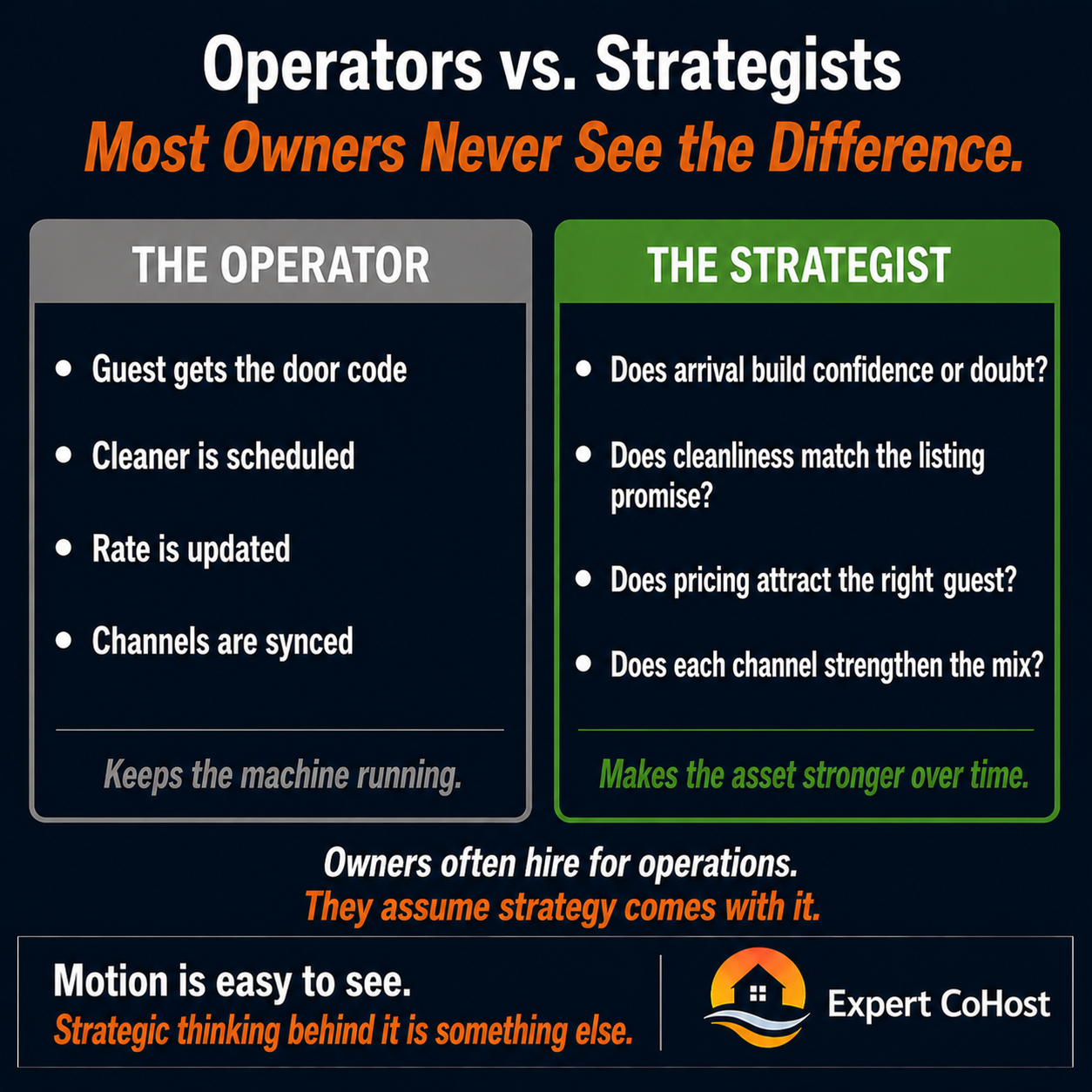
An operator makes sure the guest gets the door code.
A strategist asks whether the arrival experience builds confidence or creates doubt.
An operator makes sure the cleaner is scheduled.
A strategist asks whether cleanliness alone is enough to support the standard the listing is promising.
An operator updates the nightly rate.
A strategist asks whether the pricing supports the right guest fit, the right positioning, and the right long-term performance goals.
An operator syncs the listing to more channels.
A strategist asks whether those channels actually strengthen the booking mix or just increase complexity.
That is the difference.
Both matter.
But only one of them moves beyond keeping the machine functioning.
A Lot of Property Managers Mistake Motion for Progress
This is one of the biggest problems in the industry.
A lot of managers stay busy.
There are always messages to answer.
There are always calendars to check.
There are always turnovers to coordinate.
There are always fires to put out.
That creates motion.
And motion can look impressive.
To an owner watching from a distance, a busy manager can appear highly engaged, highly involved, and highly valuable.
But busyness is not the same as strategy.
A manager can be extremely active and still make mediocre decisions.
They can be responsive but not insightful.
They can be organized but not strategic.
They can be hardworking but still leave performance on the table.
That is the risk.
Because some managers become so consumed by operational motion that they never step back and ask the larger questions that actually change outcomes.
Strategy Starts Where Task Management Ends
This is where the stronger managers separate themselves.
A purely operational manager asks:
What needs to be done today?
A strategic manager also asks:
What needs to change so performance gets stronger over time?
That second question matters.
Because long-term property performance is not only shaped by execution. It is shaped by interpretation.
Why are guests hesitating?
Why are some reviews weaker than they should be?
Why is one channel creating more friction than another?
Why is the property underperforming in one season?
Why are more inquiries not leading to better bookings?
Why does the stay experience feel less polished than the listing promises?
Why does the property feel busy but not truly strong?
Those are not task questions.
They are strategy questions.
And they are often the questions that create the biggest gains.
Strategy Sees Patterns That Operations Alone Miss
This is one of the biggest advantages of a strategic property manager.
Operators tend to deal with events one at a time.
A guest asked a question.
A cleaner ran late.
A maintenance issue came up.
A review mentioned something small.
A booking came in from a new channel.
A guest had trouble checking in.
All of that gets handled individually.
A strategist looks for patterns.
Are guests repeatedly confused at the same point?
Is the same kind of friction showing up in different forms?
Are the reviews pointing to a recurring gap between presentation and experience?
Is the pricing creating the wrong expectations?
Is the communication tone slightly off in a way that affects trust?
Is the channel mix bringing in too much operational complexity?
That pattern recognition is powerful.
Because a manager who sees patterns can solve root problems instead of just repeatedly responding to symptoms.
That is what strategy does.
Strategy Protects the Guest Experience Before Problems Happen
Weak managers often manage reactively.
A guest has a problem.
They respond.
A review mentions confusion.
They try to clean it up afterward.
A booking channel creates friction.
They deal with the consequences.
That is still management.
But it is not high-level management.
A strategist tries to get there earlier.
They think about what the guest is likely to feel before arrival.
They think about how expectations are being set.
They think about what points in the journey create doubt.
They think about what can quietly cost trust before the guest ever complains.
That is a much more valuable level of thinking.
Because in hospitality, a lot of performance loss happens before the problem becomes visible enough to sound like a major issue.
A strategist understands that.
Strategy Connects Pricing, Positioning, and Experience
A lot of weak managers treat these as separate topics.
Pricing is one thing.
Listing quality is another.
Operations are another.
Guest communication is another.
But in real-world performance, they are connected.
Pricing influences expectation.
Positioning influences who books.
Guest fit influences friction.
Operations influence trust.
Trust influences reviews.
Reviews influence conversion.
Conversion influences long-term performance.
A strategist sees the chain.
That is what makes them more valuable than a manager who simply keeps the parts moving.
Because if the chain is weak at one point, the property can underperform even while a lot of visible work is still getting done.
Strategy Thinks About the Asset, Not Just the Calendar
This is another important difference.
A purely operational manager often focuses on what is immediately in front of them.
Tonight’s arrival.
This week’s turnovers.
This month’s occupancy.
The current message volume.
A strategist thinks more like an asset manager.
They ask:
Is this property becoming stronger over time?
Is the booking mix healthier?
Is channel dependence being reduced?
Is direct demand growing?
Is the guest experience becoming more consistent?
Is the positioning getting sharper?
Is the brand around the property becoming more credible?
Are we making decisions that support long-term resilience, not just short-term activity?
That is a different level of responsibility.
And it is one owners should care about deeply.
Because the real value of a great property manager is not just that they can keep the calendar full.
It is that they can help the asset become stronger.
Strategy Requires Judgment, Not Just Effort
This is one reason strong property managers are harder to find than many owners expect.
Operational effort can be learned and systematized.
Judgment takes more.
It takes taste.
It takes pattern recognition.
It takes perspective.
It takes experience.
It takes the ability to evaluate tradeoffs.
It takes the willingness to think instead of simply react.
That is why two managers can both work hard and still create very different outcomes.
One may stay busy and maintain activity.
The other may quietly improve pricing discipline, guest fit, channel quality, communication tone, arrival confidence, review strength, and long-term resilience.
That is the difference between effort and judgment.
And judgment is where the best managers live.
Owners Often Hire for Operations and Assume Strategy Comes With It
This is one of the most common mistakes owners make.
They look for someone who can handle the property.
Can they manage guests?
Can they coordinate cleaners?
Can they handle maintenance?
Can they keep the listing active?
Can they manage the day-to-day?
Those are fair questions.
But they are incomplete.
Because a manager can be competent operationally and still have very little strategic depth.
They may keep things afloat without ever really improving the underlying performance of the asset.
That is why owners should ask a second set of questions too.
Can they explain channel strategy?
Can they explain why the property is positioned the way it is?
Can they identify what creates friction in the guest journey?
Can they explain what kind of demand fits the home best?
Can they connect guest experience to long-term review strength and revenue quality?
Can they think beyond today’s bookings?
That is where the real difference shows up.
What Strategic Property Managers Sound Like
Owners can often hear the difference in the language.
An operational manager tends to talk about:
tasks, tools, software, response time, coordination, coverage, and execution.
A strategic manager tends to talk about:
fit, positioning, guest expectations, booking quality, channel role, long-term resilience, pattern recognition, and how decisions affect the overall performance of the asset.
That does not mean they ignore operations.
It means they understand operations as part of a bigger system.
And that is what stronger management sounds like.
What Owners Should Be Looking For
Owners do not need a property manager who uses the word “strategy” constantly.
They need one who actually thinks that way.
That usually means looking for someone who can:
-
explain why the property is performing the way it is
-
identify what is causing friction before it becomes obvious
-
connect marketing, distribution, pricing, and operations together
-
improve the guest experience intentionally rather than reactively
-
make tradeoffs that strengthen the asset over time
-
see beyond today’s booking activity
That is a much more valuable skill set than simple coordination alone.
And it is much rarer.
The Bigger Point
Operations are necessary.
But operations alone do not create strong performance.
They preserve movement.
They keep the machine running.
They support the guest stay.
They prevent obvious breakdowns.
All of that matters.
But once the basics are covered, the real difference between average managers and great ones usually comes down to strategy.
Who is seeing deeper?
Who is interpreting better?
Who is making stronger decisions?
Who is protecting the long-term strength of the asset instead of just keeping up with its short-term activity?
That is the bigger question.
And it is one more owners should be asking.
Final Thought
The best property managers are not valuable because they stay busy.
They are valuable because they think.
They think about positioning.
They think about distribution.
They think about guest psychology.
They think about expectations.
They think about what the reviews are really saying.
They think about what kind of bookings are healthiest.
They think about how to make the property stronger over time.
That is what separates a manager who operates from a manager who leads.
And that is what owners should be paying for.
Not just motion.
Strategic thinking behind the motion.